

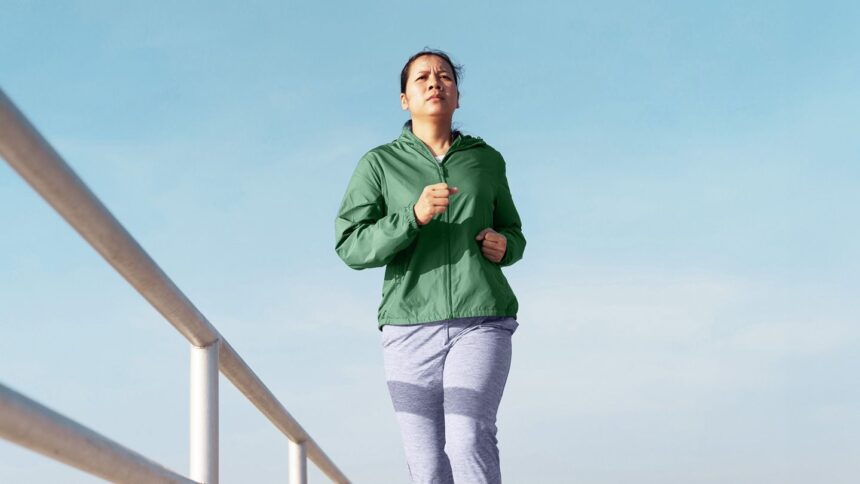
“Our findings recommend that strolling roughly 8,500 steps a day is a sensible and inexpensive technique to keep important weight reduction in the long run and stop it from gaining again on,” stated lead writer Marwan El Goho, MD, PhD, affiliate professor of meals science within the Division of Biomedical, Metabolic and Neurosciences, College of Modena-Reggio Emilia, Italy. Dr. El Goho’s group will current their findings this week on the 2026 European Congress on Weight problems in Istanbul, Turkey.
Figuring out this technique “could be of nice medical worth,” El Gogh says, provided that about 4 in 5 obese or overweight sufferers are inclined to regain all or a few of their weight inside three to 5 years after initially dropping it.
Individuals who maintained their strolling habits continued to shed pounds
To reach at their findings, researchers analyzed 14 beforehand printed trials involving obese or overweight adults. The typical age of contributors was 53 years and BMI was 31.
Throughout all trials, roughly 2,000 individuals had been randomly chosen to finish the approach to life modification program. An additional 1,800 individuals had been within the management group, who both obtained solely weight-reduction plan remedy, no recommendation in any respect, or had been on a ready listing for remedy.
The approach to life program included instruction on enhancing weight-reduction plan, in addition to recommendation to stroll extra and rely day by day steps. Every program included a weight reduction part (about 8 months on common) adopted by a weight upkeep part (about 10 months), and the aim was long-term weight reduction.
The researchers measured contributors’ day by day steps 3 times: in the beginning of the research and on the finish of the load loss and weight upkeep phases.
Initially, the 2 teams had comparable step counts (suggesting that they had comparable exercise ranges). The approach to life change group took about 7,300 steps per day, whereas the management group took 7,200 steps per day.
The management group didn’t considerably improve their step rely or shed pounds throughout the trial. Nevertheless, adults within the way of life modification group elevated their day by day step rely to about 8,500 steps by the tip of the load loss part. In addition they misplaced 4.39 p.c of their physique weight, or a mean of about 9 kilos.
By the tip of the load upkeep part, they had been nonetheless averaging about 8,200 steps per day and had misplaced 7 of the 9 kilos they misplaced.
Considerably surprisingly, though greater step counts had been related to higher long-term weight upkeep, they did not appear to affect weight reduction at that stage of the trial, El Gogh says.
“One potential clarification is that in aggressive weight reduction, calorie discount might have a better impression on the size than strolling,” he says.
Strolling might compensate for slower metabolism
Whereas this evaluation wasn’t designed to have a look at the “why” behind the findings, El Gogh presents some theories about how taking 8,500 day by day steps might counteract frequent the reason why individuals acquire weight again.
After weight reduction, your metabolism might decelerate. After you shed pounds, your physique tries to preserve vitality, so you might burn fewer energy. That is generally known as metabolic adaptation. Sustaining your exercise degree might offset among the decline throughout weight upkeep, El Gogh says.
Outdated habits can creep again in. Many individuals begin gaining weight again after they return to their pre-weight loss weight-reduction plan and exercise patterns, he says. Individuals who saved strolling may not have fallen into that sample, he says.
Sustaining your weight requires a long-term mindset, says El Gogh. “The largest mistake is for sufferers to consider the tip of the load loss part as a ‘end line’ relatively than a lifelong, everlasting change,” he says.
Is 8,500 steps a day actually sufficient?
These findings are “affordable and constant” with what is understood about strolling and weight reduction, stated Brian Wojek, MD, MPH, an assistant professor, endocrinologist, and weight problems skilled at Yale Faculty of Drugs in New Haven, Connecticut, who was not concerned within the research. However in his opinion, 8,500 steps a day might not be sufficient bodily exercise to maintain the load you have misplaced from gaining again.
“For most individuals, I like to recommend strolling not less than 8,500 steps,” says Dr. Wojek.
“The advantages transcend simply weight upkeep; train additionally advantages insulin sensitivity, cardiometabolic well being, muscle high quality and energy, and bone well being,” he says.
Based on Wojek, including depth or high-impact coaching to your exercise can present advantages that steps alone do not present.
That does not imply strolling can not help keep weight, he says. “This can be a affordable start line, particularly for individuals who aren’t very lively proper now,” Wojeck says.
“Perfection is the enemy of progress. For those who’re not strolling proper now, attempt transferring extra. If you’re, see in the event you can add steps, hills, or one other sort of motion to what you are doing,” says Wojek.
The best way to add extra steps and construct from there
Based on El Gogh, you needn’t stroll 8,500 steps (about 4 miles) at a time. For most individuals, he says, it is simpler to “stack” further actions into your day by day routine.
El Ghoch presents the next options for rising your step rely:
- Please park additional away from the doorway or get off the bus one cease early. In that case, your step rely might improve by about 800 to 1,000 steps.
- Use the steps as an alternative of the elevator or escalator.
- Stroll whereas on the cellphone. A ten-minute pacing name can add roughly 500 to 1,000 steps.
- For those who can, stroll for 5 minutes each hour throughout your workday, he says, including as much as about 3,500 steps in eight hours.
- If you’re prepared, improve your depth by strolling sooner, strolling uphill, or selecting a route with stairs.
In case your joints damage, select a low-impact choice, Wojek says. “Swimming, water aerobics, and the elliptical are good beginning factors,” he says.