

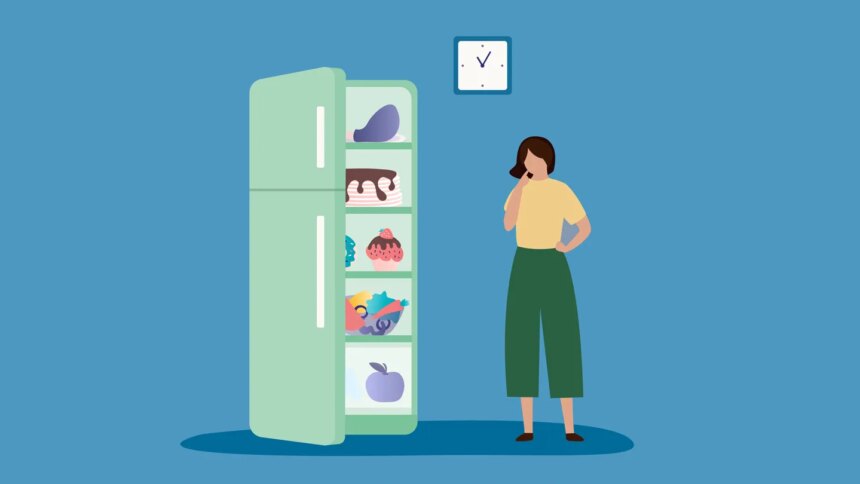
There are a lot of the explanation why you do not eat late at evening as a approach to take care of stress. Analysis reveals that the behavior can intrude along with your physique’s pure rhythms, disrupt your sleep, and enhance your danger of weight acquire.
A brand new research reveals another excuse to keep away from late-night snacking. Meaning it might probably impair your intestine well being and trigger digestive issues.
For some individuals, the stress brought on by these digestive issues can result in a self-perpetuating cycle, says Ashkan Farhadi, MD, a gastroenterologist at MemorialCare Orange Coast Medical Middle in Fountain Valley, Calif., who was not concerned within the research.
“If you happen to eat too near bedtime, your intestine will not be happy,” Dr. Farhadi says. “In case your intestine isn’t glad, you’re going to be depressing.”
Consultants say this affiliation isn’t any coincidence. Here is why:
The research analyzed intestine well being and dietary knowledge from greater than 15,000 individuals.
For the research, researchers analyzed knowledge from greater than 15,000 grownup individuals from two long-term research: the Nationwide Well being and Diet Examination Survey (NHANES) and the American Intestine Mission. They centered on late evening snackers, outlined as adults who eat 25 p.c or extra of their each day energy after 9 p.m.
Within the first section of the research, researchers analyzed NHANES individuals’ well being indicators associated to continual stress, together with blood strain, ldl cholesterol, and BMI. Members additionally reported the standard of their poop utilizing the Bristol Stool Chart.
This extensively used instrument charges feces on a scale of 1 to 7 based mostly on form and consistency. Kind 1 appears to be like like arduous lumps or small pebbles and suggests constipation. Kind 7 on the opposite aspect is free and watery, suggesting diarrhea. Gastroenterologists take into account Sorts 3 and 4 to be excellent.
The researchers discovered that individuals who scored excessive on stress measures within the first section of the research and mentioned they ate greater than 25 p.c of their each day energy after 9 p.m. had been 1.7 instances extra prone to expertise constipation or diarrhea than individuals who scored low on stress measures and ate fewer late-night snacks.
The researchers additionally regarded on the well being of the individuals’ intestine microbiota.
If individuals ate late at evening after they had been careworn, they had been 2.5 instances extra prone to report intestinal issues comparable to constipation or diarrhea. This group additionally had considerably decrease intestine microbiota variety, suggesting that the mix of stress and late-night snacking could have a larger influence on the intestine microbiota than stress alone.
“It isn’t nearly late-night snacking,” says Harika Dadigiri, M.D., lead writer of the research and a New York Medical College resident at St. Mary’s St. Clare Hospital. “If you happen to’re already below continual stress and snacking late at evening, it might probably disrupt your circadian rhythm and alter your bowel habits.”
How late evening snacking impacts bowel regularity
The research didn’t discover the hyperlink between stress, late-night consuming, and adjustments within the intestine microbiome, however there are a number of theories.
After you eat, your intestines change into digestive mode, Farhadi explains. “There’s motion within the intestines, vitamins are absorbed, and that is plenty of work for the intestines,” he says. Then, about three hours later, as soon as digestion is full, the intestines transfer into what is known as the migratory motor advanced (MMC). Farhadi describes this as intestinal housekeeping.
This sweeps micro organism, meals, and different particles towards the colon, and the method repeats each 90 to 120 minutes, Farhadi says. “It cleans your digestive tract and prepares you for the subsequent day,” he says.
Nonetheless, if you eat a late evening snack, this digestive course of is delayed and interrupted by sleep. “Meaning much less tidying up of the intestines,” says Farhadi. This will result in bacterial overgrowth within the intestines, rising the danger of constipation and diarrhea, he explains.
Marie Bolm, MD, MPH, chair of the Division of Gastroenterology at George Washington College College of Medication, says late-night snacking can “exaggerate” the results of stress on the intestine, altering the intestine microbiome and finally affecting intestine perform.
Snack kind could also be essential
Snack alternative may affect how disruptive nighttime snacking is. “If the meals is fatty, it takes longer to digest,” Farhadi says. Meaning the intestine would not go into “housekeeping mode” till a lot later, he provides.
“Meals excessive in salt, fats, and sugar can put plenty of stress in your intestine, they usually’re not the very best for selling restful sleep and intestine well being,” Cording says.
Limitations to contemplate
The research is predicated on self-reported knowledge on meal and snack timing, so it’s topic to bias and inaccuracy. Moreover, though the Bristol Stool Chart is usually used within the medical subject to trace stool traits and adjustments, it may be subjective and the values had been self-reported.
The proper time for the final snack of the day
Dr. Bolm recommends consuming your final meals of the day early within the night, if potential. “Not consuming three to 4 hours earlier than bedtime can assist digestion and is an efficient technique for aligning along with your pure circadian rhythm,” she says.
If you happen to’re hungry and need one thing after your final meal, Cording recommends consuming one thing simply digestible, like a banana, a boiled egg, or a small bowl of oatmeal.
If you happen to’ve tried this and are nonetheless having hassle with constipation or diarrhea, Farhadi recommends seeing your physician.